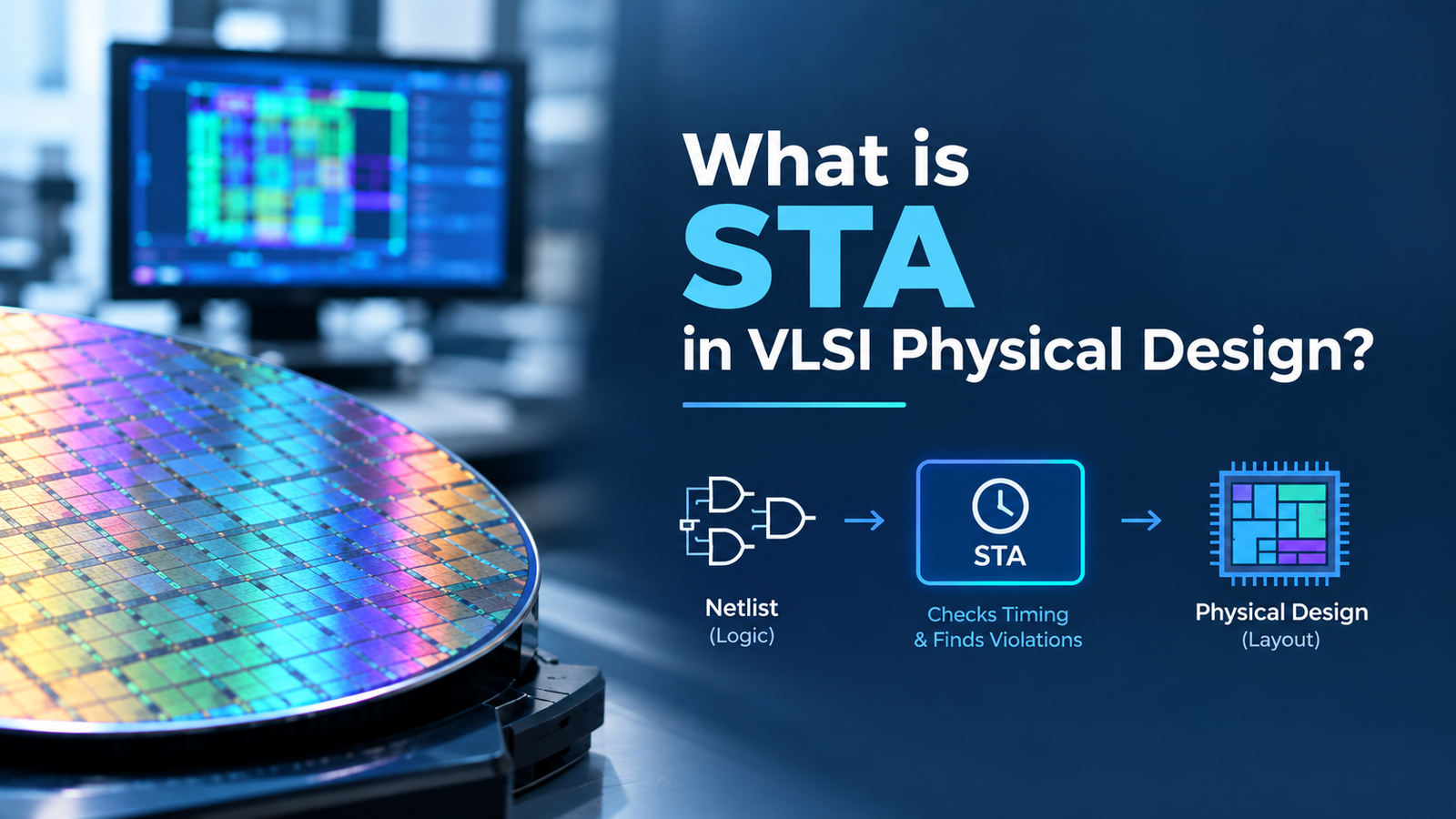
What is STA(Static Timing Analysis) in VLSI Physical Design ?
“Will the signal reach on time?”
Sounds like a simple question, right? But inside a chip, this one question can decide whether the chip works perfectly or fails completely.
I understood its importance when I was selected at HCLTech as a Physical Design Engineer in the STA domain. I chose STA because it offered exactly what I was looking for : learning concepts, going deep into them, analysing different situations, and finally applying that knowledge practically.
But what exactly is STA?
Static Timing Analysis, or STA , is a method used to check whether every signal inside the chip reaches the correct destination at the correct time. it analyses different timing paths without applying countless input combinations.
Here is a simple analogy.
Imagine you have to catch a train . You must reach the platform before the train departs, but you also cannot leave your seat immediately after boarding. Reaching late is similar to a setup violation, while not remaining stable for the required time is like a hold violation. Setup and Hold still giving “Wait…what?” energy? Same until I saw them working in a real project! Stay tuned because I’ll be decoding these concepts next in the simplest way possible.
I had also studied these terms through Prof. Bishnu Prasad Das’s online course hosted by IIT Roorkee (Physical Design using Static Timing Analysis). The videos and notes gave me direction, but honestly setup and hold equations still felt like a puzzle.
Then came the turning point.
When I received the project exposure at HCLTech, those equations finally started making sense. I could see how engineers analyze multiple scenarios and ensure that the design runs at the required speed.
If Physical Design creates the routes inside a chip, STA acts like Google Maps, Checking whether every signal can reach its destination on time. That is when I realized: STA is not only about equations. It is about making sure the chip never misses its timing.
If you liked this blog follow me for more, share it with your chip-design squad, comment down below your suggestions and the topics which you liked to be explained in easy and interesting way, and let’s make timing analysis finally click!